Your safety is our priority
The tire plays a major role since it is the only link between the ground and the vehicle. So it is important to choose the right tire for the right usage.
Michelin helps you choose your tires and maintenance, and to identify handling difficulties.
Why do tires matter?
Tires play an essential role because they are the only link between the vehicle and the road.
Maintain your tires
To get the most out of your tires you’ll need to maintain them properly. It’s not as complicated as it sounds, and we’re here to help.
Recognize handling difficulties
It isn't always easy to get to the bottom of the reasons for different performance issues.
Tires aren't always the only factor to consider.
When should I change my tires?
Worn tires can ruin your vehicle's performance and even endanger you or your loved ones.
Improving road safety
Governments, international organizations and businesses must step up their efforts to make roads safer for everyone, and run awareness-raising and training schemes for all road users.
EVERYDAY INNOVATION
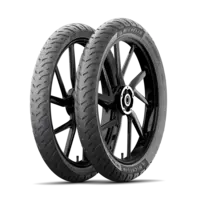
Michelin PILOT STREET 2
Excellent performance on both wet and dry roads for everyday use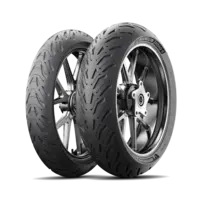
Michelin ROAD 6
Legendary performance... improved! (1,2)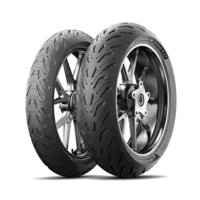
Michelin ROAD 6 GT
LEGENDARY PERFORMANCE… IMPROVED! (1,2)
Michelin ROAD 5
Maximum confidence in wet and dry conditions mile After mile
Michelin PILOT STREET RADIAL
The radial revolution for added riding enjoyment on smaller motorcycles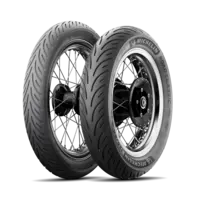
Michelin ROAD CLASSIC
Modern technologies to make the most of your classic bike!


FAQ
Read our Frequently Asked Questions.
Break-in period: all new Michelin motorcycle tires require 100–200 km of gentle riding before full grip is available. Avoid hard cornering, aggressive braking, or full throttle during this period.
Always use the same tire line front and rear: Michelin develops front and rear tires as a system. Mixing different Michelin lines or mixing with other brands undermines the engineered performance balance.
Check pressure before every ride: motorcycle tire pressure is especially sensitive to temperature changes. Michelin recommends checking cold, before each ride.
Respect load and speed ratings: never exceed the load index or speed rating specified for your bike.
Inspect regularly: check for embedded objects, sidewall damage, and tread depth before every ride.
The effect is dramatically more pronounced on motorcycles. A car with slightly incorrect pressure handles similarly—a motorcycle can feel completely different. Underinflation on a motorcycle produces a vague, sluggish steering feel, reduced precision in corners, and a 'swimming' sensation at speed. Overinflation creates an overly nervous, twitchy feel with reduced contact patch and reduced grip, particularly on textured or uneven road surfaces. Even 2–3 psi off the correct specification can be felt clearly. This is why Michelin recommends checking motorcycle tire pressure before every ride—not monthly as for car tires.
Sport and road motorcycle tires should not be used in conditions below approximately 5°C where grip is significantly reduced. Standard road motorcycle tires use compounds that stiffen in cold and lose grip on frozen or near-frozen surfaces. This is not just about riding in snow—riding on cold, wet roads on a cold day dramatically reduces grip below what the tire delivers in warmer conditions. If you're a year-round rider in Canada, use appropriate cold-weather compounds, ride at appropriately reduced speeds and lean angles, and avoid riding at all when ice is possible.
Directional tires are designed to rotate in one specific direction—the tread pattern is optimized for water evacuation and grip in that direction. Most modern Michelin motorcycle tires are directional. Look for an arrow molded into the sidewall or shoulder of the tire indicating the correct rotation direction. Installing a directional tire in the wrong direction significantly reduces its performance—particularly wet-weather grip. When mounting new tires, verify the arrow points in the direction of forward rotation before installation.
Look for the Michelin Man symbol on the upper sidewall—it marks the location of the tread wear indicator in the groove below it. When the tread surface wears down to the same level as this small raised indicator, the tire has reached its legal wear limit (typically 1 mm for motorcycle tires). Michelin strongly advises replacement before reaching this level—wet-weather grip degrades significantly before the absolute wear limit. Visually, you can also see that the tread grooves have nearly disappeared: at the wear limit, the tire is effectively smooth across much of the tread width.
Related articles
-
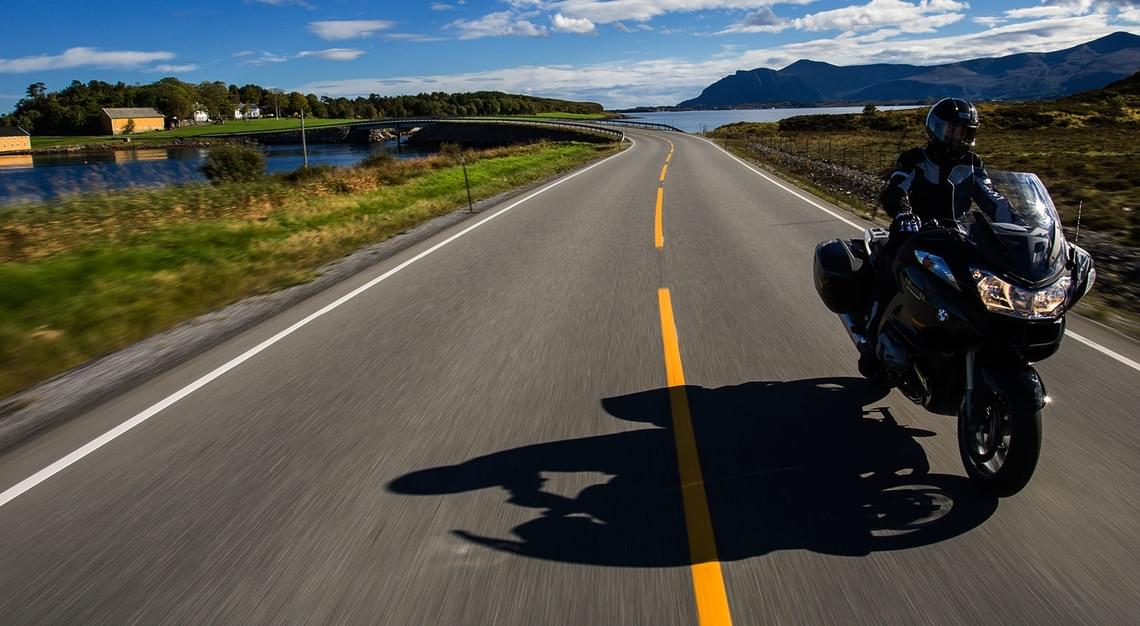
Tips to enjoy your motorcycle trip
Discover all our tips to enjoy the rideView more -

Recognize tire handling difficulties
It isn't always easy to get to the bottom of the reasons for different performance issues. Performance issues may be caused by the tires (e.g. type of tire, incorrect pressure) and/or a change to the vehicle (e.g. accessories, load). Tires aren't always the only factor to consider.View more