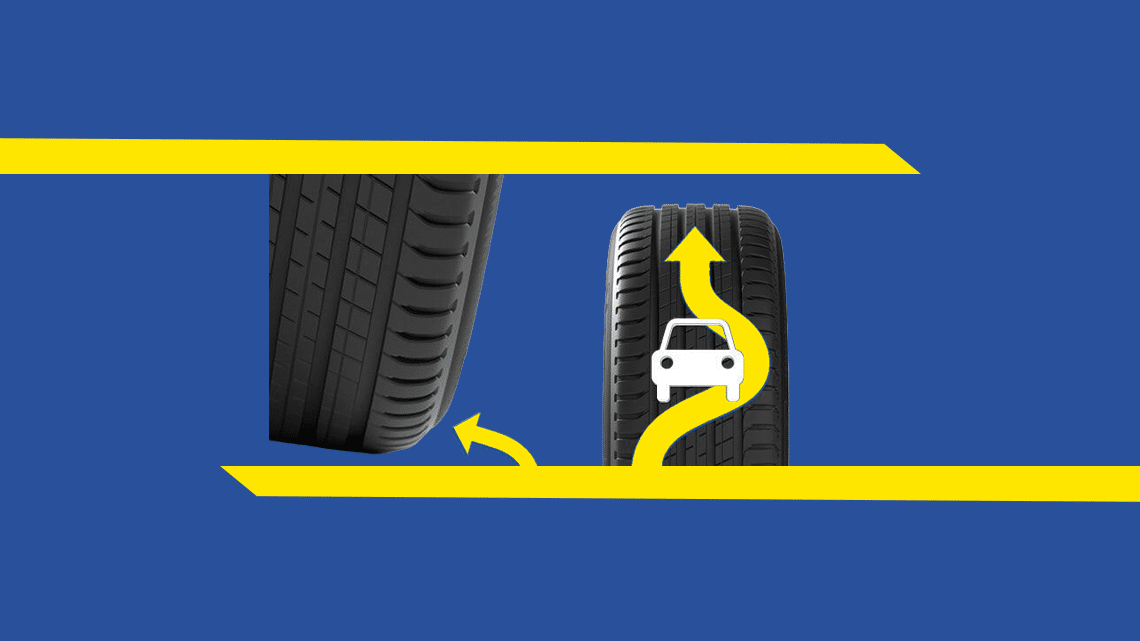
Symptoms: Pulling to One Side or Poor Steering
Diagnostic: Poor Alignment
Proper alignment is necessary for both even treadwear and precise steering. You need an alignment when you notice:
Uneven front or rear tire wear
Changes in your vehicle's handling or steering response (e.g., pulling to one side)
Solution:
Many vehicles today are equipped with rear suspensions that can be adjusted for alignment. If this is the case, your vehicle may need a "front end" alignment or a "four wheel" alignment, depending on the symptoms you are experiencing. See your local Michelin authorized tire dealer for an inspection.

FIND A DEALER
FAQ
Read our Frequently Asked Questions.
Wheel misalignment: the most common cause—one or more wheels are angled incorrectly, causing uneven tire contact. Fix: wheel alignment service.
Uneven tire pressure: a tire significantly lower on one side creates uneven rolling resistance. Fix: inflate all tires to placard pressure.
Uneven tire wear: tires with different tread depths create different rolling radii, pulling toward the more worn side. Fix: rotation or replacement.
Brake caliper sticking: a seized caliper applies constant braking force on one side. Causes pulling under braking specifically. Fix: brake service.
Conicity defect: rare manufacturing defect where the tire's structure is slightly conical rather than cylindrical—causes directional pull.
Short-term, mild pulling is usually not immediately dangerous, but should be addressed promptly. A car that pulls significantly can be tiring to control on long drives and can contribute to accidents in emergency situations where you need the vehicle to track straight reliably. If the pull appeared suddenly after an impact or is worsening, pull over and inspect for a flat or damaged tire before continuing. Persistent pulling is always a sign of something that needs professional attention—don't normalize it.
Yes, in rare cases. Tire conicity—a subtle manufacturing variation where the tire's internal structure is slightly asymmetrical—can cause directional pull. It's most noticeable with new tires because worn tires have adapted to their position. If a new tire causes pulling, try rotating the suspect tire from front to rear: if the pull reverses direction or stops, conicity is the likely cause. Most tire manufacturers and retailers will replace a tire confirmed to have a conicity defect under warranty.
Brake-pull is typically not an alignment issue—it's most commonly a brake problem, specifically a sticking caliper on the side the car pulls toward (applying more braking force than the opposite side), or uneven brake pad wear. It can also be caused by significantly different tire pressures or tread depths side-to-side. Have your brakes and tires inspected together when this symptom appears. Brake-pull that's ignored can worsen dramatically and become dangerous in emergency braking situations.
Most roads are cambered (sloped toward the shoulder for drainage), which creates a mild tendency for vehicles to drift toward the shoulder. If your car pulls left and right when you change lanes on a road with opposing camber, that's normal road camber effect—not a vehicle problem. If the pull is consistent regardless of road camber, or if it appears on flat surfaces like parking lots, the cause is in the vehicle (alignment, tires, or brakes). A simple test: if the car pulls equally left when in the right lane and right when in the left lane, that's camber. If it always pulls the same direction, it's the car.