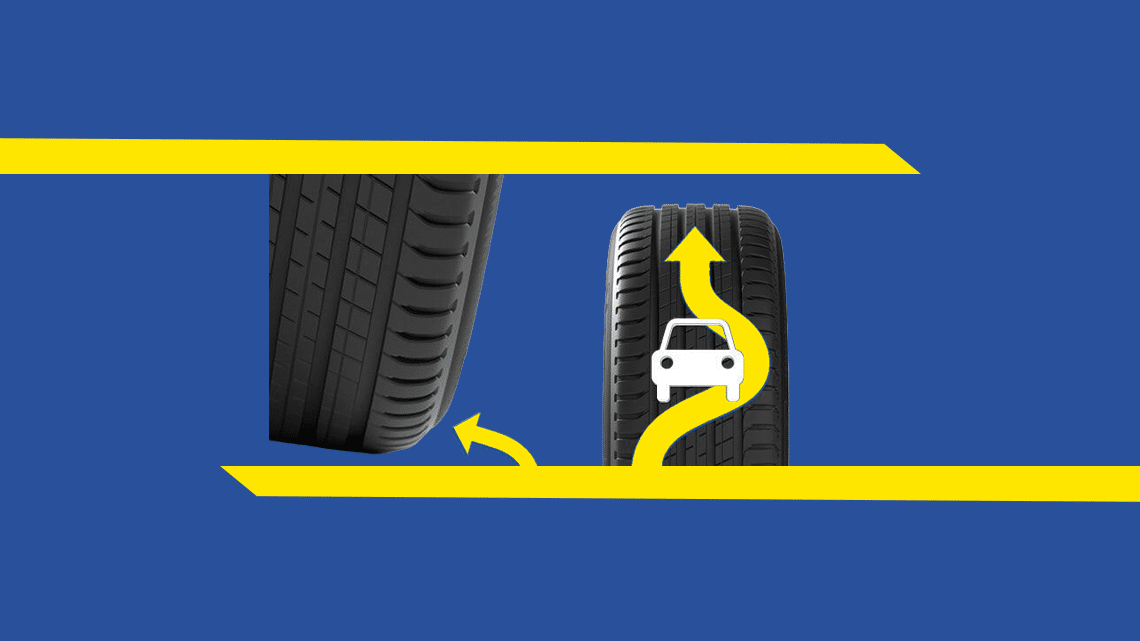
Symptom: Poor Alignment
Diagnostic: Poor Alignment
You need an alignment when you notice:
Uneven front or rear tire wear
Generates excessive heat, which reduces tire durability and can lead to tire failure.
Changes in your vehicle's handling or steering response (e.g., pulling to one side)
Solution:
Many vehicles today are equipped with rear suspensions that can be adjusted for alignment. If this is the case, your vehicle may need a "front end" alignment or a "four wheel" alignment, depending on the symptoms you are experiencing. See your local Michelin authorized tire dealer for service and inspection.
If your tire continues to lose pressure, visit your local authorized Michelin tire dealer.

FIND A DEALER
FAQ
Read our Frequently Asked Questions.
Center wear (more worn in the middle): overinflation. Reduce to the vehicle placard pressure.
Edge wear (both shoulders worn, center fine): underinflation. Inflate to placard pressure immediately.
One-sided wear (one edge worn faster): wheel misalignment. Get alignment checked.
Cupping or scalloping (wavy, high-low pattern): worn or damaged shock absorbers/struts, or out-of-balance wheel.
Feathering (tread blocks with smooth on one side, sharp on other): toe misalignment.
Diagonal wear pattern: combination of misalignment and imbalance—requires full suspension inspection.
You can, but with important rules: new tires should always go on the rear axle, regardless of drivetrain type. The rear axle controls stability—having more tread there helps prevent oversteer (rear-end slides) in wet or slippery conditions. Never put a new tire on the rear and a worn one on the front of the same axle. On AWD vehicles, check the owner's manual carefully—some AWD systems require all four tires to be within a specific tread depth of each other to avoid transfer case damage.
Insurance: in Canada, damage to tires from road hazards (potholes, nails, debris) is generally covered under comprehensive insurance, not collision. Many policies require a specific road hazard endorsement. If you have a tire warranty or road hazard protection plan from your dealer, file the claim promptly—most have time and documentation requirements. Vehicle manufacturer warranty: driving on demonstrably damaged tires can void warranty coverage for related suspension and wheel damage if the manufacturer can show tire condition contributed to the failure.
Wear is the gradual, expected reduction in tread depth from normal use. Damage is sudden, abnormal deterioration from external causes (impacts, objects, misuse). This distinction matters for warranty: tread life warranties cover accelerated or premature wear but typically exclude damage. A tire that blows out from a pothole impact is a damage claim, not a warranty claim. Keeping records of regular maintenance (rotation receipts, pressure check logs) strengthens any wear-related warranty claim by demonstrating proper care.
Tire wear becomes a safety issue at 4/32" (3.2mm) in wet and winter conditions—at this point, wet braking distances are meaningfully longer than with new tires. It becomes a legal issue at 2/32" (1.6mm). The zone between 4/32" and 2/32" is where the tire still passes a legal inspection but is performing significantly below its designed capability. Michelin recommends proactive replacement at 4/32" for winter conditions and no lower than 3/32" for summer use as a practical safety threshold rather than a legal one.