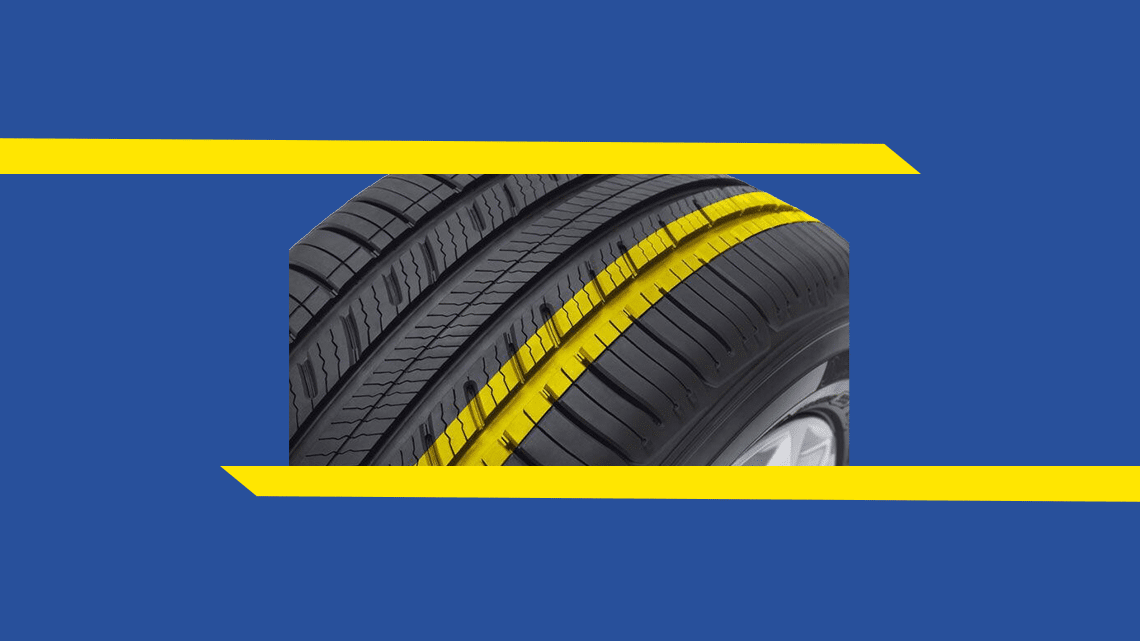
Symptom: Worn Out Tires
Diagnostic: We recommend replacing your tire if:
The tread is worn beyond the recommended tread depth levels. In this video, the Weather Channel's Paul Goodloe and MICHELIN®'s Sarah Robinson show how you can easily check if your tires need to be replaced.
Solution:
1. Inspect your tire regularly and look for:
Uneven tread wear
Shallow tread
Troublemakers (rocks, nails, etc.)
Damaged areas
Damaged valve caps
2. Pay attention to the “feel” of your tires as you drive.
A rough ride may indicate tire damage or excessive wear.
If you notice vibrations or other disturbances while driving, immediately reduce speed, drive with caution until you can safely pull off the road and stop, and inspect your tires.
If a tire is damaged, deflate it and replace it with your spare. If you do not see any tire damage and cannot identify the source of the vibration, take the vehicle to a tire dealer for a thorough inspection.
3. See a professional
If you see something you’re not sure about during your inspection, have it examined by your tire dealer.

FIND A DEALER
FAQ
Read our Frequently Asked Questions.
Tread wear indicators: small raised bars molded into the grooves become flush with the tread surface at 1.6mm (2/32")—replace immediately.
Coin test: insert a Canadian quarter into the tread with the caribou nose pointing down—if it's fully visible, the tread is too low.
Tread depth gauge: the most accurate method—gives a precise reading in mm or 32nds of an inch.
Performance changes: noticeably longer stopping distances, reduced wet-road traction, or hydroplaning at lower speeds all indicate worn tires.
Visual inspection: exposed cords, fabric, or metal visible in the tread area means immediate replacement is required.
Legally, in most Canadian provinces, the minimum tread depth is 1.6mm (2/32"). Driving below this is illegal and can result in fines, but more importantly, it's genuinely dangerous. At 2/32" tread depth, wet stopping distances increase dramatically. For winter tires, the practical safe minimum is 4/32" (3.2mm)—below this, winter tires lose their meaningful performance advantage over all-season tires. Treating the legal minimum as the safety minimum is a false economy that puts you and others at risk.
Yes. Worn tires affect multiple vehicle systems. ABS and traction control performance depends entirely on tire-to-road grip—worn tires mean these systems engage earlier and are less effective. Braking distances increase significantly with worn tread. Worn tires are also more susceptible to punctures and blowouts because the tread structure is thinner and less able to absorb impacts. Fuel economy is typically marginally worse with very worn tires, and handling precision degrades as the tire's structural rigidity decreases.
The quarter coin test is the most reliable household method in Canada: insert a quarter into the deepest tread groove with the caribou nose pointing toward the tire. If the caribou's nose is completely covered by tread, you're above 6/32". If the nose tip is visible, your tread is approaching replacement territory. For winter tires specifically, if the nose of the caribou on a quarter is visible when inserted into the tread, you're at or below 4/32"—the recommended replacement threshold for winter use. A tread depth gauge (available for a few dollars) gives precise readings and is well worth having.
Tire performance degrades progressively with wear—it doesn't suddenly become dangerous at 2/32" and perfectly safe at 3/32". Wet braking distances increase measurably as tread depth decreases from 8/32" downward. Hydroplaning resistance drops as the channels that evacuate water become shallower. Winter traction begins declining below 5–6/32" on winter tires. This is why Michelin recommends paying attention to performance changes—longer stops, less confident wet handling, more road noise—rather than waiting for the wear indicators to appear.